Saturday, May 4, 2013

Global Warming

Global Warming is a very controversial topic between many politicians, scientists, and other researchers all over the world. Is it very difficult to decide whether environmental changes are actually occurring, or if we are just going through an ironic cycle of weather patterns. The temperature of the earth as well as levels of carbon dioxide ave varied greatly on cycles for thousands of years. Although these conditions fluctuant, the GHG concentration stays fairly stable as the amount of GHG's emitted into the atmosphere seems to balance with the amount of GHG's that are absorbed back into the Earth. This is what allows humans to live in the somewhat stable climate that we know today. Although it does not seem very harsh on the surface, the plants and wildlife are unable to keep up with the swift cycles that the Earth is moving through. 


url.jpg

For more information on Global waning, visit:
http://environment.nationalgeographic.com/environment/global-warming/gw-overview#

Enjoy!
TLR


Thursday, April 4, 2013

Up The Yangtze

The Three Gorges Dam, in China, is the world's largest producer of hydroelectric power. Though it has brought about many new economic strengths to the country, there have also been many downfalls. One of the main issues is the relocation of people and resources throughout China as a result of the construction of the dam. Throughout the process, there have been over 1.3 million people along with 13+ cities relocated or separated.  

Three Gorges Dam
As we watched the movie Up The Yangtze, some of the reasoning behind the citizens' support for the dam became a little more comprehendible. The dam was built to bring lots of clean and pure energy to the country and the world. The citizens which were relocated saw this as a very good thing for their country, thus making them want to give up everything they had ever worked towards building. Though they lost their homes, they saw it as working towards the greater good of the society that they lived in so that progress could be made.

Tuesday, March 12, 2013

Paper

Paper is a very fragile and delicate thing, yet it is used multiple times for many different activities. Though societies use many different types of paper in every day life, very rare is it for someone to stop and consider what steps were taken in order for that paper to be produced. While doing research on the different locations in which the trees originate, the amount of trees, or even the type of trees used to produce some of our everyday paper products, I found that companies have many restrictions on letting go of their "secrets." It is extremely difficult to find out any information about a product as simple as paper, partially because of the company's policies, and also because trees are cut down every single day across the world and are not always cut down for a specific reason, leaving no trace to the forests in which they came from. 


From many hours of researching, I finally came across a website which laid out the percentages of forests which were used to make paper, yet even these websites could not explain what kind of paper was produced from each forrest.
Website: http://www.conservatree.org/paperlisteningstudy/Forests/question64.html


  • Supposedly, 42% of the total wood harvested each year is turned into some type of paper. 
  • In years to come, this number is projected to reach approximately 50%.
  • Though that does not seem like much, imagine the amount of paper that is produced and used every year, and imagine the existing 50% which is being cut down for other reasons.


Here is a picture which shows the Life Cycle Analysis of paper in a chart very similar to that which we discussed during class:  Life Cycle of Paper

It may not be much information, but finding out the little bits of how much forest is actually being used helped tremendously in finding the real root of where all paper originates.

Enjoy!
TLR


Wednesday, January 23, 2013

Water Quality in China


China's water quality has gradually decreased over the years, and it seems to be decreasing faster than some may notice. Approximately half of China's water supply is said to be polluted with harmful substances from factory pollution as well as other pollution inserted straight into the water. The quality of the water has decreased 25% in the past two years, and may have decreased even further then that. The government of China has not posted statistics on their water clarity since 2009.


I chose this topic because I believe that water quality is an extremely important aspect of today's society. If a community does not know the dangers in the water that they are consuming, the number of health problems in the future may become endless. The factories in China are not up-to-date with their machinery, which prevents the filtration that actually does occur to not be nearly as effective with clearing out new metals etc. that are being inserted into the water.


Here is a website that helps to describe the many issues with the water pollution in China:

 Enjoy!
TLR

Tuesday, January 15, 2013

Haiku Exercise

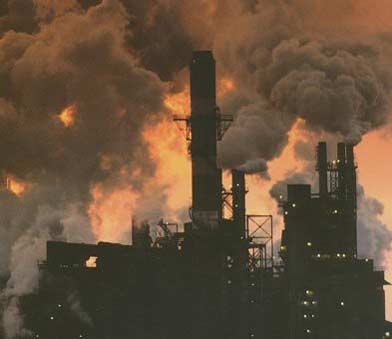
The purpose of this exercise was to critically analyze and evaluate a concern to the social media, while also conveying a new product which is relevant to photographs about the topic a hand. The concern that I chose to write about is the issue of pollution. Every day, there is more and more pollution emitted into the air that we breathe. This short Haiku gives some insight onto the thoughts that one may have when viewing pollution.

"We look to the sky,
 The stacks are billowing smoke,
 Pollution has come."


Here is a quick website that discusses some of the effects of pollution on the environment created by the Massachusetts Department of Environmental Protection: http://www.mass.gov/dep/air/aq/env_effects.htm


Enjoy! 
TLR